News
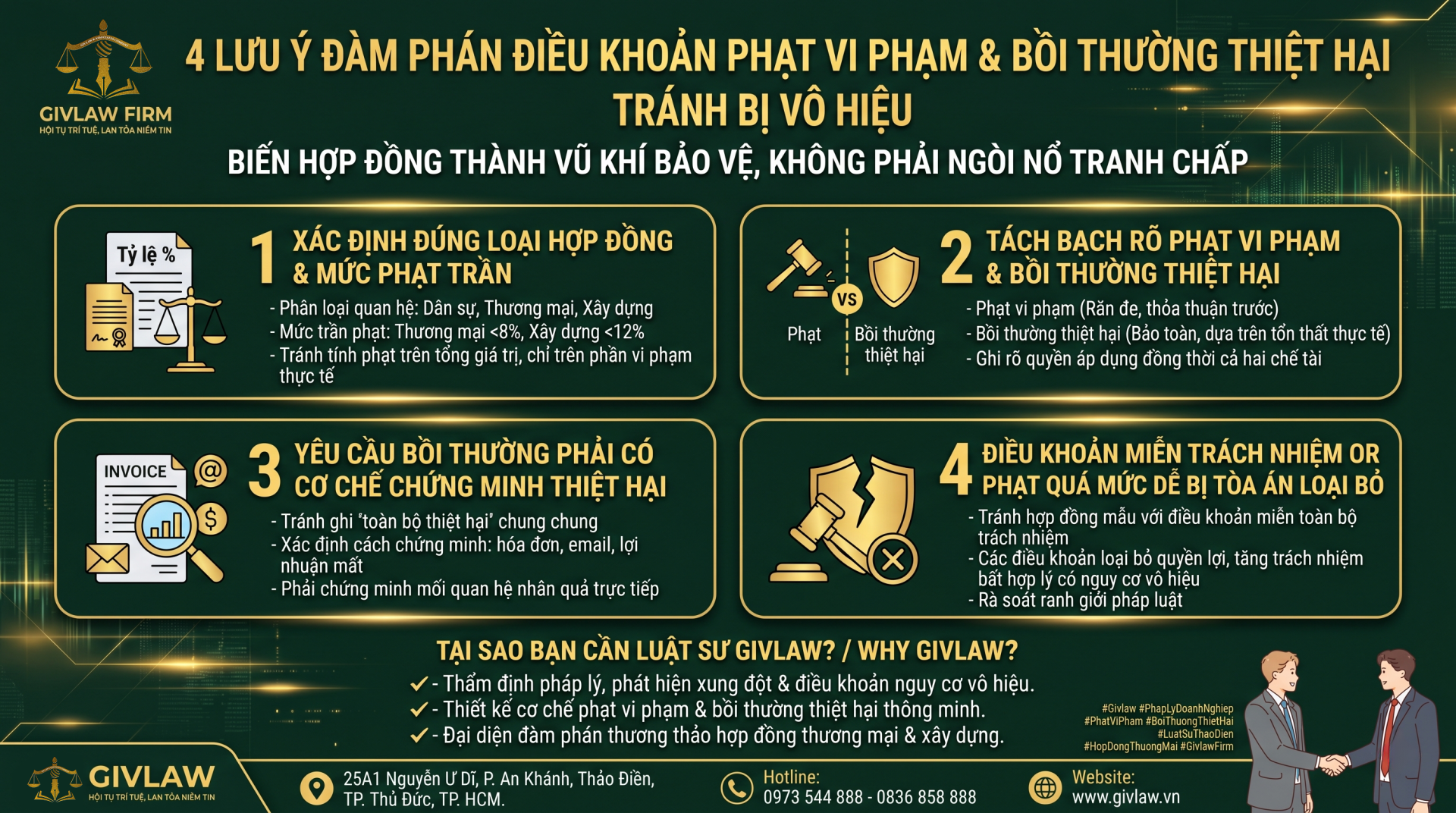
During the drafting and negotiation of commercial contracts, remedy clauses are frequently the epicenter of business disputes. Imposing excessive penalties or drafting damage clauses without a solid statutory foundation will not only fail to protect a business but also expose the contract to the risk of being declared void by Courts or Arbitration tribunals.
To transform your contract into a robust shield rather than a trigger for litigation, Givlaw Firm highlights 4 critical legal considerations:
Different types of contractual relationships are governed by distinct legislation, which dictates entirely different maximum limits (statutory caps) for breach penalties.
Commercial Contracts: Pursuant to Article 301 of the Commercial Law 2005, the penalty for a breach of contract shall be agreed upon by the parties but shall not exceed 8% of the value of the breached contractual obligation portion.
Construction Contracts: For projects utilizing state budget funds, the maximum penalty can escalate up to 12% of the breached contract value (Construction Law).
Pure Civil Contracts: The Civil Code 2015 does not impose a statutory cap on breach penalties, allowing parties full freedom of agreement.
⚠️ Common Mistake: Businesses frequently calculate the penalty percentage based on the total contract value rather than the actual value of the breached obligation portion. This often leads to the penalty clause being partially invalidated for exceeding the statutory cap.
Breach penalties and compensation for damages are two entirely independent remedies in terms of both objective and application conditions:
Breach Penalty: Acts as a deterrent and punishment for non-compliance, set as a specific figure or percentage at the time of contract execution. This remedy is triggered immediately upon the occurrence of a breach, without the need to prove actual financial loss.
Compensation for Damages: Aims to restore the injured party to their original financial position. This remedy strictly requires proof of actual, objective, and direct losses.
???? Critical Note for Businesses: According to Clause 2, Article 307 of the Commercial Law 2005, if the parties do not explicitly agree to apply both remedies concurrently, the aggrieved party only holds the right to demand the breach penalty. Therefore, our lawyers strongly advise incorporating the following language: "The aggrieved party reserves the right to simultaneously apply breach penalties and claim compensation for actual damages."
A business cannot simply rely on generic phrasing such as "The breaching party shall compensate for all arising damages". In any dispute resolution forum, the burden of proof rests entirely on the claimant. If you fail to substantiate three elements: (i) The breach event, (ii) The existence of actual, direct damages, and (iii) The proximate causal relationship, the claim will be dismissed.
To proactively mitigate this risk, the contract should outline specific documentation protocols for gathering evidence, including:
Invoices and payment vouchers issued to third parties for rectification or damage control.
Inspection and acceptance minutes detailing defects, official warning emails, and breach notices signed by both parties.
Verifiable data proving direct loss of profits caused by the counterparty’s delays or non-performance.
Major corporations often leverage template agreements or superior bargaining power to insert terms that entirely exempt them from liability or impose unconscionable indemnification burdens on the weaker counterparty.
However, judicial authorities naturally tend to strike down clauses that violate the core principles of fairness and voluntariness enshrined in the Civil Code, or those that strip away statutory rights. Before signing, businesses must ensure balanced exemption mechanisms based on:
Force Majeure events (clearly defined and operationally feasible).
Fault attributable entirely to the counterparty or a third party.
Breaches resulting directly from compliance with state authority directives.
Structuring tight, legally enforceable remedy clauses that maintain deterrent value requires practical strategy and seasoned legal insight. At Givlaw, we deliver absolute peace of mind to enterprises through:
Rigorous contract review to identify and remedy vulnerabilities vulnerable to judicial invalidation.
Tailor-made drafting of penalty, damage, and retention of title clauses customized to specific industry nuances.
Strategic representation during contract negotiations and dispute resolutions before Courts and Commercial Arbitration Centers.
Contact Givlaw Firm today to safeguard your capital and legal interests:
???? Office: 25A1 Nguyen U Di, An Khanh Ward, Thao Dien, Thu Duc City, HCMC.
???? Hotline: 0973 544 888 - 0836 858 888
???? Website: www.givlaw.vn