News
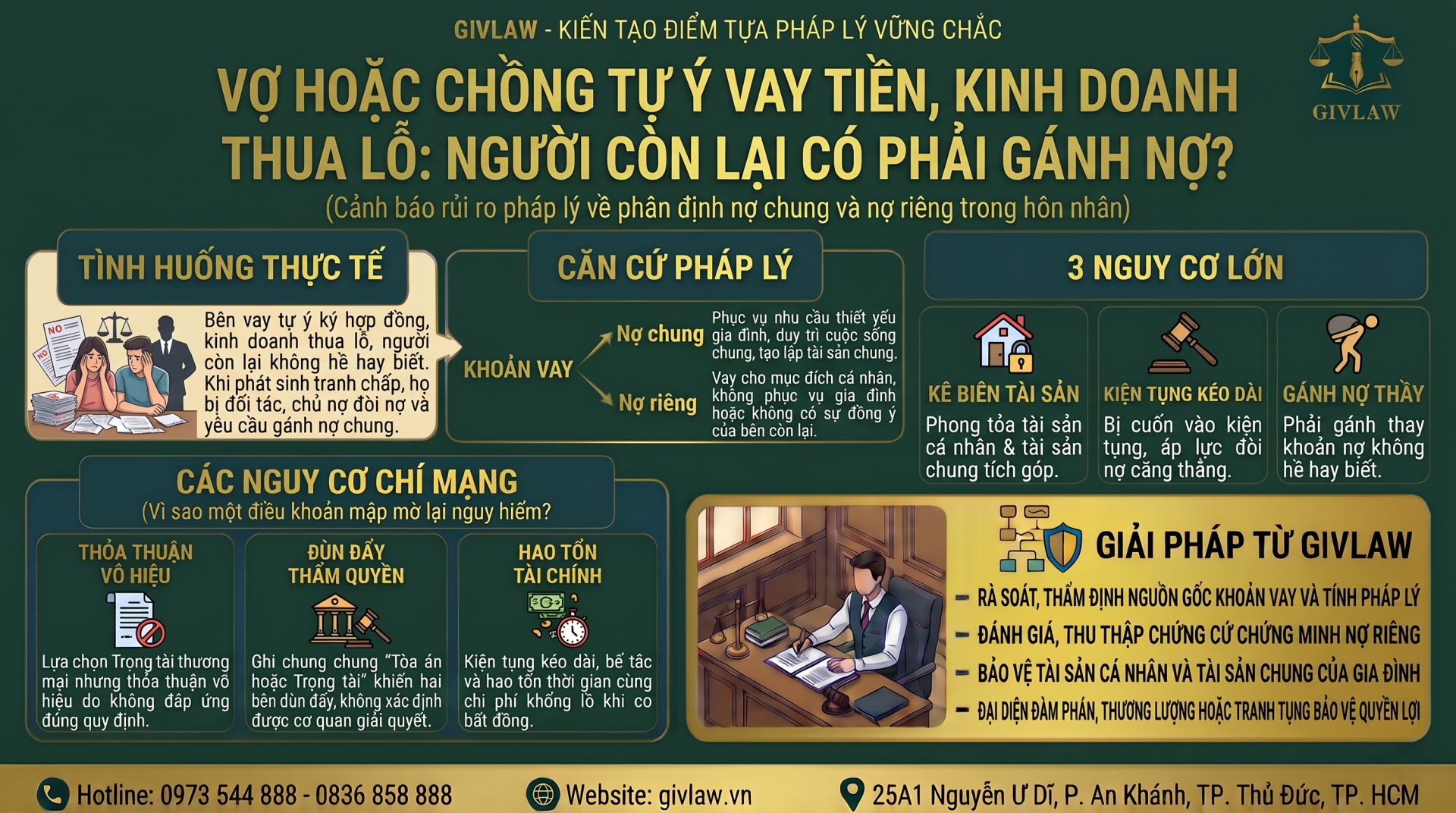
When one spouse independently borrows money for business purposes but subsequently incurs losses and becomes unable to repay the debt, disputes may arise concerning marital liabilities and jointly owned assets.
Is the other spouse automatically exempt from repayment obligations simply because they did not sign the loan agreement, participate in the transaction, or know about the borrowing?
The answer depends on the purpose of the loan, the nature of the transaction, any agreement between the spouses, and the applicable legal provisions.
Under Vietnam’s Law on Marriage and Family 2014, a spouse’s debt repayment obligations are determined by the nature of the transaction and the relevant legal grounds.
Article 37 of the Law on Marriage and Family 2014 provides for joint property obligations in circumstances including:
Transactions jointly agreed upon by both spouses.
Transactions entered into by one spouse to meet the family’s essential needs.
Obligations arising from the possession, use, or disposal of jointly owned property.
Other circumstances prescribed by law.
Therefore, the fact that only one spouse signed a loan agreement is not, by itself, conclusive in determining the other spouse’s liability.
However, a business loan does not automatically become a joint debt merely because the borrower is married. The purpose of the loan, any agreement between the spouses, the actual use of the funds, and relevant evidence must be examined.
Under Article 45 of the Law on Marriage and Family 2014, personal property obligations may include obligations arising from transactions independently entered into by one spouse for purposes unrelated to the family’s needs in circumstances prescribed by law, as well as other personal obligations established by law.
If one spouse independently borrows money for a separate business purpose and there are no sufficient legal grounds to classify the debt as a joint obligation, the other spouse is not automatically required to repay it.
The classification must be determined based on the transaction documents, the purpose for which the funds were used, any agreement between the spouses, and the applicable law.
When a debt dispute arises, determining which assets may be used for repayment depends on whether the debt is classified as a joint or personal obligation, as well as the applicable rules governing marital property and civil judgment enforcement.
If a debt is established as a joint obligation, jointly owned assets may be used to satisfy that obligation in accordance with the law.
Conversely, if the debt is personal, asset enforcement must comply with the legal rules applicable to the individual spouse’s obligations. Not every jointly owned asset, nor every asset registered in the other spouse’s name, is automatically available to satisfy the debt.
A careful review of loan documents, financial records, the origin of the assets, and ownership rights is therefore essential before reaching a legal conclusion.
When a spouse discovers that a loan may affect their legal interests, they should consider taking the following steps:
Collect relevant documents: Loan agreements, debt acknowledgments, bank transfer records, business documents, and communications concerning the borrowing.
Clarify how the funds were used: Determine whether the money was used for a separate business activity, family needs, or another purpose.
Review asset ownership: Identify jointly owned and separate assets, their sources of acquisition, and any related transactions.
Assess the legal grounds: Review the applicable rules on joint and personal obligations and the burden of proof in dispute resolution.
Seek legal advice when necessary: Obtain legal advice promptly upon receiving a repayment demand, a lawsuit notice, or documents relating to asset enforcement.
Preparing adequate evidence and developing an appropriate response at an early stage can help reduce legal risks and protect the parties’ lawful rights and interests.
Disputes concerning joint and personal debts in marriage cannot be resolved solely by determining who signed the loan agreement. Each case requires an assessment of the relevant documents, evidence, and applicable legal provisions.
GIVLAW provides legal consultation and assistance in resolving disputes involving marital financial obligations, marital property, and related legal issues.
Our legal team reviews relevant documents, assesses the legal grounds, and advises on appropriate courses of action tailored to each case to protect clients’ lawful rights and interests.
Contact GIVLAW for legal advice tailored to your circumstances.
GIVLAW Law Firm
Address: 25A1 Nguyen U Di Street, An Khanh Ward, Ho Chi Minh City, Vietnam
Hotline: +84 973 544 888 – +84 836 858 888
Website: https://givlaw.vn
Legal Disclaimer: This article is intended for general legal information only and does not constitute legal advice for any specific case. Debt liability must be determined based on the relevant documents, evidence, and laws applicable at the time the matter is resolved.